Can Solar By Itself Get You Off the Grid?
When you're looking to go off grid, there are several options, but you'll usually start by asking one question: can solar alone get me off grid?
The short answer is yes — with a few things you need to know first. This is the oldest post on the ranch blog, first written in 2021, and it still holds up. I've been living on solar out here in Northern Arizona since then, so this version has more scar tissue in it. Here's the expanded, tightened, been-through-it version.
Cloudy days are fine. Let's kill the myth first: you don't need every day sunny to go solar. Panels keep producing in fog and overcast on ambient light. Not at full power — expect a fraction of rated output on a heavy overcast day — but they don't stop. And cold actually helps them: panels lose efficiency as they heat up, so a cool bright day outperforms a scorching one with the same sun. What cloudy stretches really hit is your battery math. One gray day is nothing. Three in a row is when your bank starts telling you the truth. Size for the bad week, not the good day.
You have to know your numbers. The average American home runs roughly 900 kilowatt-hours a month — some states run higher, some lower. Off grid, that number is everything, and yours needs to be smaller. List everything you'll run, find the wattage, multiply by the hours, add it up honest. Then cut. A chest fridge instead of a full-size, LED everything, a laptop instead of a desktop — the cheapest panel is the one you never had to buy. Then size the system with a solar calculator and give yourself more than you think you need. A little extra panel is cheap. Coming up short isn't.
Off-grid or grid-tied? A grid-tied system has no batteries. You make power, use what you need, and send the rest to the grid — then buy it back at night, and lose everything the moment the grid goes down. It's cheaper up front, and the utility is your battery. But read that last part again: when the grid goes down, a grid-tied system goes down with it, even in full sun. That's not off grid. That's a discount program.
True off grid means battery storage: panels charge the batteries all day, batteries carry you through the night. You become your own utility — generation, storage, and distribution, all yours. More money up front, more responsibility forever, and no power bill and no blackout, ever. That's the system that actually gets you off the grid.
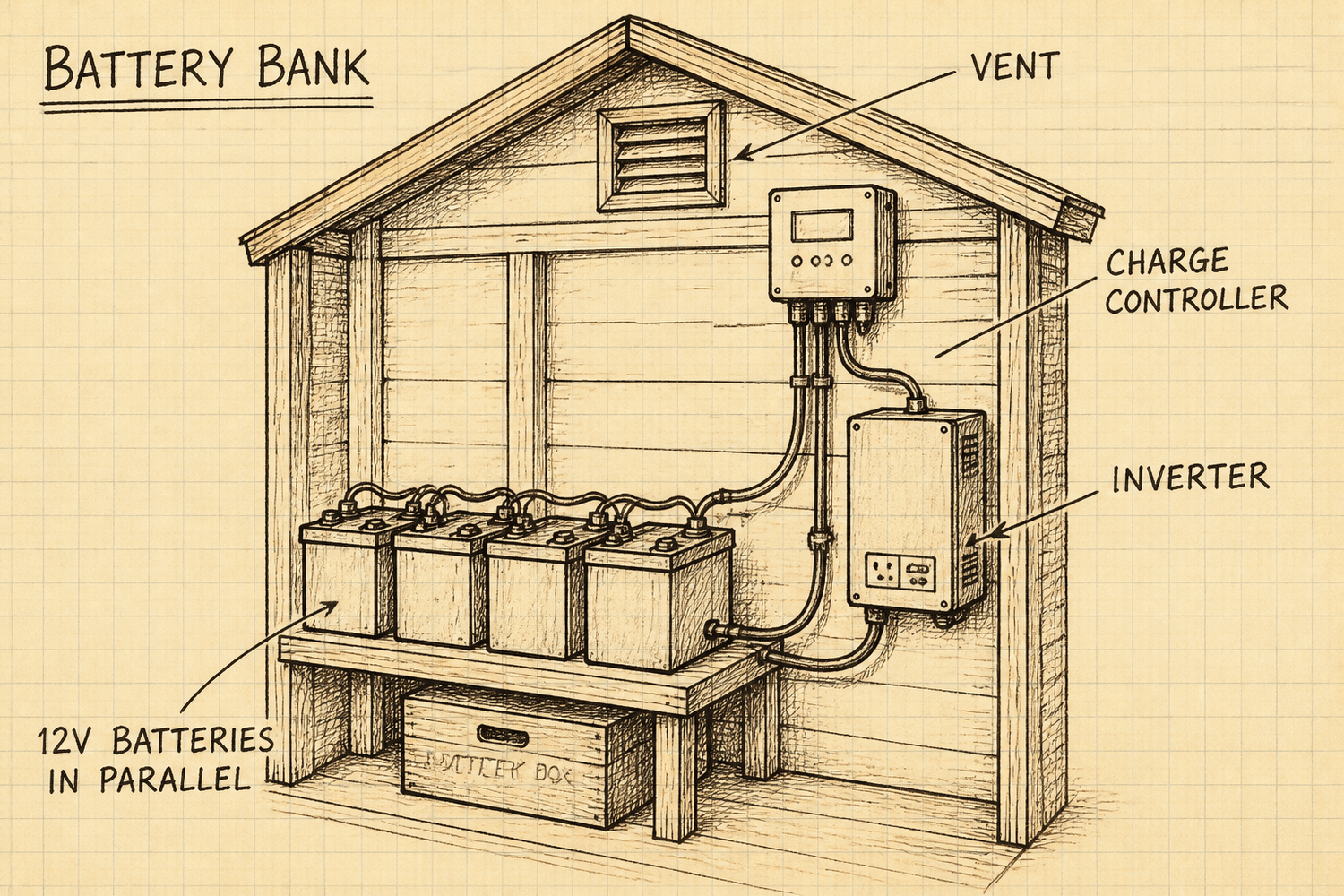
Battery bank basics. Your batteries are the heart of the system, and they're where beginners get burned. Three things to know. First, chemistry: lithium (LiFePO4) costs more up front and lasts many more cycles; lead-acid costs less and punishes you for discharging it deep. Second, depth of discharge: don't plan to use everything in the bank — lead-acid wants to stay above half, lithium can go much deeper but still doesn't love sitting empty. Third, capacity math: figure your daily watt-hours, multiply by the number of gray days you want to survive, and add headroom. Out here in the high desert I plan for the cold snap that brings three dark days and a demand spike. The bank that carries it is the bank that lets you sleep.
Panel placement and angle. Panels want full sun, and "full sun" means more than pointing them up. Face them true south (in the northern hemisphere), tilt them roughly at your latitude, and then get obsessive about shade — a shadow on one corner of a panel can choke the whole string's output. Watch your site across a full day and a full year before you mount anything permanent; the sun sits low in winter and high in summer, and a spot that's perfect in June can sit in shade half the day in December. If you can, adjust tilt seasonally — steeper for winter sun, shallower for summer. And mount them where you can reach them with a broom and a rag, not on a roof you need a ladder and a prayer to clean.
Maintenance, and what kills solar systems in the desert. Solar is low-maintenance, not no-maintenance. Dust is the desert's tax: a filthy panel quietly loses output long before you notice, so wipe them down on a schedule. Heat ages everything — batteries especially — so give your bank shade and airflow, not a hot box. Check connections for corrosion and critter damage; rodents chew wires like it's their job. And watch your charge controller's logs — drifting numbers are how you find a failing panel or a bad connection before it becomes a dead morning. The systems that die out here don't usually die of anything dramatic. They die of a loose connection nobody checked for a year.
Redundancy: don't build one system, build several. Here's the lesson I'm building the whole ranch around: one big system is a single point of failure. A lightning strike, a controller failure, a wiring fire — anything that takes out the main system takes out everything with it. So I'm running separate independent systems — one per structure — so no single event can kill the whole ranch. Each one is smaller and simpler, each one can be worked on without shutting down the rest, and if one goes down, I still have light, water pumping, and a way to charge a phone while I fix it. Same logic as water: never one tank, never one everything. Redundancy isn't paranoia. It's how you stay living out here when something breaks — and something always breaks.
Should solar be your only system? You can run everything on solar and it generally works fine — if you have room for more panel than you need and enough battery for the long cloudy stretches. But putting all your eggs in one basket can bite you. A second, simpler backup — a small generator for the worst stretches, or a second independent bank — doesn't have to cost much, and the week your main system is down, you'll be glad it's there.
Twenty years ago, 100 percent off-grid solar wasn't realistic. Today it's not only viable — it's practical, and out here in Northern Arizona it's how we're building.
The off-grid power ebook — the honest numbers version of this post, expanded: dub.co/solar-guide [build this link in Dub.co]
The Definitive Guide to Hauling Water — $39.99 with code WATER101, because power without water is still a campsite: dub.co/water-guide
Book a consult and talk through your setup one-on-one: dub.co/appt
Everything else we use and sell: dub.co/store
What would you add to this story — what did solar alone get you through, and where did it come up short? Tell me in the comments.